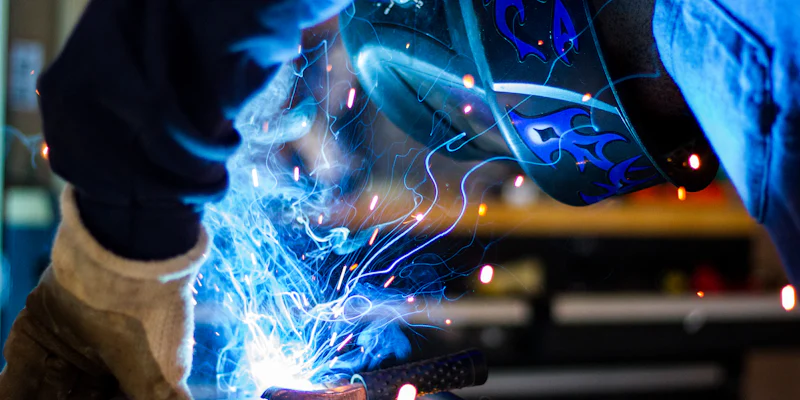
Weld quality determines the durability and look of a gate or railing. An explanation of the two common welding methods and how to inspect welds.
Looking at a stainless steel gate, the easiest way to tell a careful workshop from a sloppy one is the welds. A bad weld not only spoils the look but is also a weak point prone to rust and cracks. This article explains the two common welding methods for stainless steel.
TIG welding
TIG (Tungsten Inert Gas) uses a non-consumable tungsten electrode with argon shielding gas. The welder holds a separate filler rod in the other hand.
Pros:
- Small, clean welds with little spatter.
- Good heat control, limiting warping of thin tube.
- Suited to visible details, thin box sections and joints that need to look good.
Cons: slower, and requires high skill.
MIG welding
MIG (Metal Inert Gas) uses a wire that is fed continuously and automatically, usually with a mixed argon shielding gas.
Pros: fast, suited to long welds and thick material. Cons: more spatter, rougher welds, and more grinding needed.
For household gates and railings made from thin box sections, many workshops choose TIG for visible joints so the welds are neat and need less grinding.
Why does the shielding gas matter?
When welding, molten metal oxidizes very easily. Argon gas forms a protective shield. If gas is lacking or a strong draft blows in, the weld becomes pitted, black and loses its corrosion resistance. For sealed hollow tube welds, many cases also need protection of the inside of the weld.
Post-weld steps
- Grinding and polishing: make the weld flat and bring it to the same shine as the surrounding surface.
- Weld cleaning (pickling): remove the heat-tint oxide layer (yellow, blue, purple) with a cleaning solution or electrochemically.
- Passivation: helps the surface rebuild its anti-rust film.
- Cleaning: remove abrasive grit and iron particles that stuck on.
If the pickling and passivation steps are skipped, welds easily yellow or rust early even when the material is good.
How to check welds yourself on delivery
- Welds are even and continuous, with no pits and no burn-through.
- No fine cracks around the weld.
- The color around the weld is no longer strongly yellow, blue or purple.
- Pull and shake the frame lightly to see if any joint is loose.
- For ground welds, the surface must be flat, not dished.
Welds and rust resistance
304 stainless steel welded with correct technique and surface-treated keeps almost all of its corrosion resistance. Welding at the wrong heat or with the wrong type of filler can make the weld zone less durable. So ask the workshop about the type of rod or wire and the post-weld treatment process.
Tips when choosing a workshop
Look at photos of real projects, especially close-ups of welds. Ask to see a sample product or an unpolished weld if you need to. A professional workshop will gladly explain its process.
- #hàn inox
- #TIG
- #MIG
- #gia công