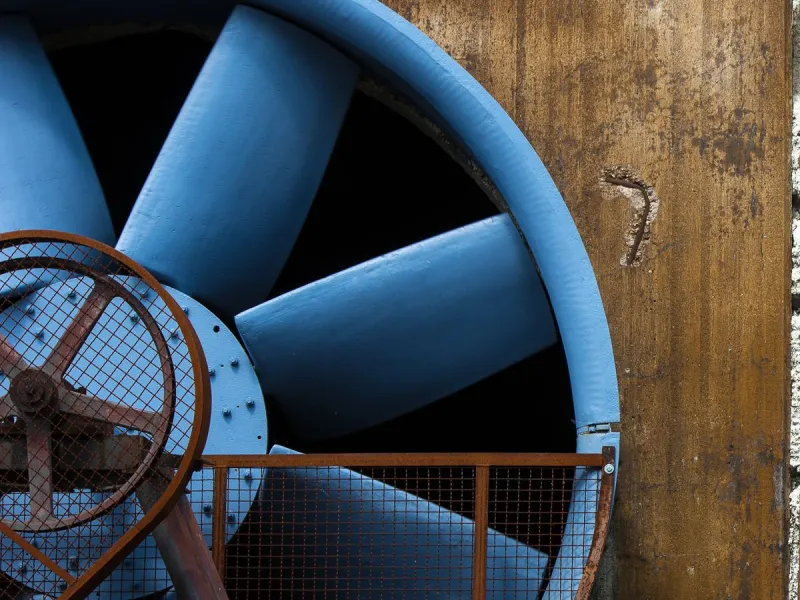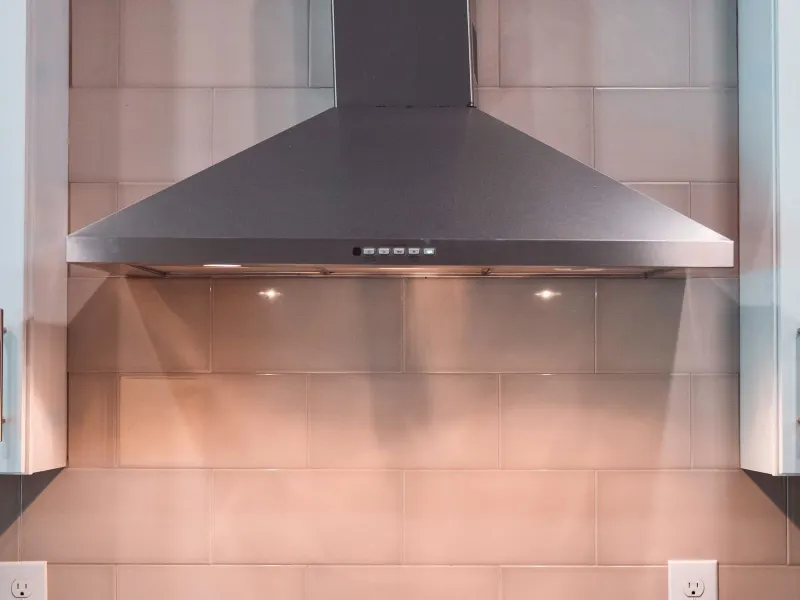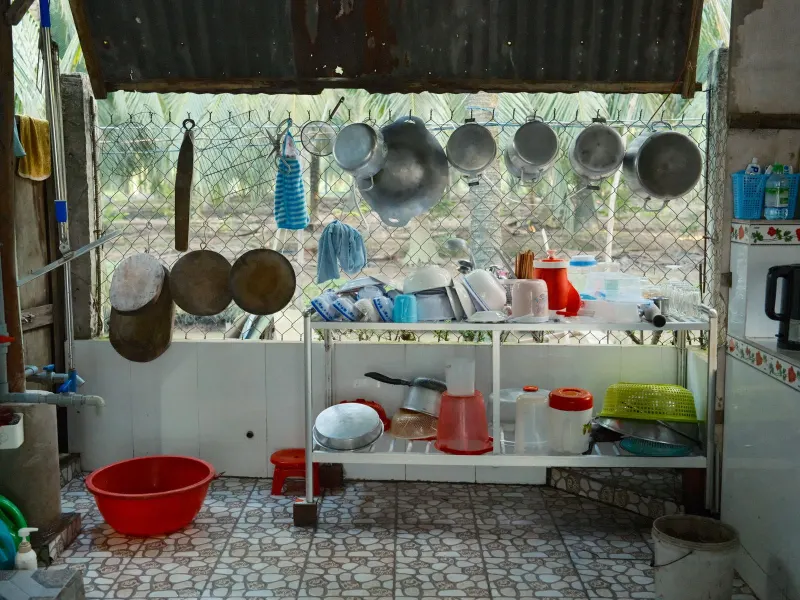
Two reference ways to calculate the airflow for a restaurant kitchen hood: by the hood face area and by the kitchen volume.
A hood that is too small or a fan that is too weak lets smoke and grease odors spill into the dining area. On the other hand, a fan that is too strong also pulls out the cool air-conditioned air and wastes electricity. This article presents two reference ways of calculating to choose a fan for a restaurant kitchen.
Note: the figures below are only reference levels to give you an initial picture. A surveying technician will adjust for the type of kitchen, ceiling height and the actual length of duct.
Method 1: by the hood face area
Reference formula:
Q = A x v x 3600
Where:
- Q: the airflow to be extracted, in m³/h.
- A: the flat area of the hood face, in m² (length x width of the hood).
- v: the velocity of air drawn through the hood face, in m/s. Values commonly used for quick calculations are in the range 0.25 to 0.5 m/s; for kitchens with a lot of grease and big flames, choose the higher level.
- 3600: converts seconds to hours.
Worked example: a hood 2.0 m long and 1.0 m wide gives A = 2.0 m². If you choose v = 0.4 m/s then Q = 2.0 x 0.4 x 3600 = 2.880 m³/h. This is the airflow needed at the hood face, before losses.
Method 2: by kitchen volume
Reference formula:
Q = V x N
- V: the volume of the kitchen (length x width x height), in m³.
- N: the number of air changes per hour. Restaurant kitchens are usually referenced in the range of 20 to 40 changes per hour depending on the amount of cooking.
Worked example: a kitchen 6 m x 5 m x 3 m has V = 90 m³. Choosing N = 30 gives Q = 90 x 30 = 2.700 m³/h.
The two methods give close results in the example above, but this is not always the case. When the two results differ, take the larger value as the basis and then ask a technician to re-check.
Add a safety margin
Air passing through grease filters, long ducts and many elbows is resisted, so the fan needs spare capacity. The usual practice is to add a margin, for example 10 to 20 percent, and then choose a fan whose airflow equals or exceeds that number at the required static pressure. Read the fan performance curve rather than looking only at the maximum airflow figure.
Static pressure and ducting
Besides airflow, you need to care about static pressure (Pa): the push needed to move air through the grease filter, elbows, tees and the length of duct. Tips to reduce air resistance:
- Limit the number of 90-degree elbows; use rounded elbows instead of sharp ones.
- Run the duct straight and as short as possible.
- Choose a duct diameter large enough that the air velocity in the duct is not so high that it makes noise.
- Keep the grease filter clean; a dirty filter can reduce airflow considerably.
Make-up air: the part often forgotten
For every amount of air extracted, the same amount must come back in. If the kitchen is sealed, the fan will draw air backward from other exhausts, pulling odors from the toilet area or making doors hard to open. Leave an air intake opening or a make-up air fan opposite the hood.
Choosing the hood size
The hood should be wider than the cooking line by some margin on each side (technicians usually leave a few tens of centimeters) to catch vapor rising to the sides. A hood that is too tight or too high above the cooking surface lets smoke escape.
Need help calculating for your kitchen?
Every kitchen is different: the number of burners, the type of fuel, ceiling height and exhaust location. The Phu Phong workshop surveys for free in Long Xuyen and the surrounding area, measures and proposes a suitable hood size, ducting and fan. All figures in this article are for reference only; an official quote is only given after a survey.
- #chup-hut-khoi
- #bep-nha-hang
- #cong-thuc